Advanced Procedures Designed for Faster Recovery and Better Outcomes
Shoulder pain caused by arthritis, severe fractures, or tendon damage can significantly affect a person’s quality of life. When conservative treatments such as physiotherapy, medications, and injections fail to provide relief, shoulder replacement surgery becomes a highly effective solution.
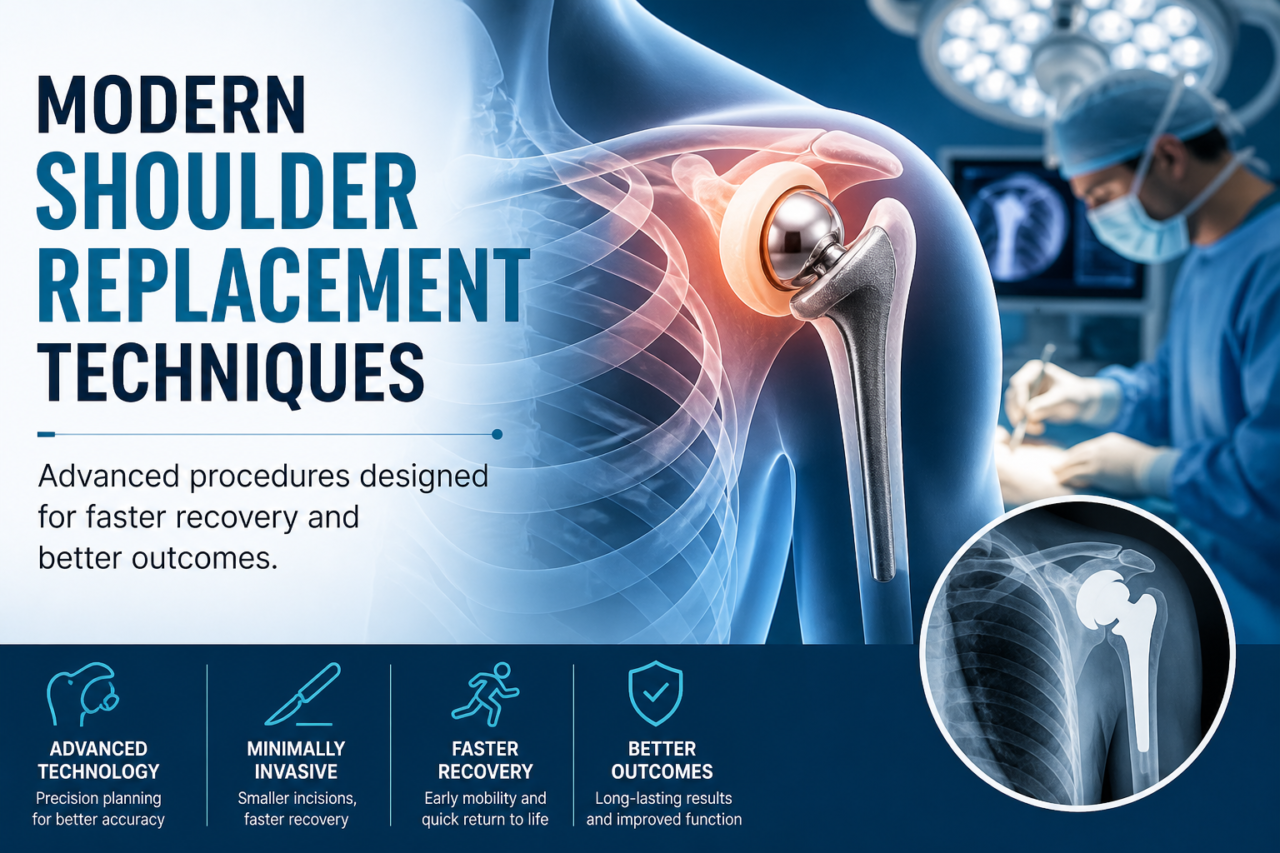
Thanks to advances in orthopedic technology and surgical techniques, modern shoulder replacement procedures provide faster recovery, improved mobility, and longer-lasting results. Today, surgeons can use minimally invasive techniques, advanced implants, and computer-guided systems to achieve better outcomes for patients.
Understanding Shoulder Replacement Surgery
Shoulder replacement surgery, also known as shoulder arthroplasty, involves replacing damaged parts of the shoulder joint with artificial components (prostheses).
The shoulder is a ball-and-socket joint, where the head of the humerus (upper arm bone) fits into the glenoid socket of the scapula (shoulder blade). When these surfaces become damaged due to arthritis or injury, pain and stiffness can develop.
Modern surgical techniques allow orthopedic surgeons to replace these damaged surfaces with prosthetic implants that restore normal joint function.
Common Conditions That Require Shoulder Replacement
1. Osteoarthritis
The most common reason for shoulder replacement. Cartilage gradually wears away, causing bone-on-bone friction.
2. Rheumatoid Arthritis
An autoimmune disease that causes inflammation and joint damage.
3. Rotator Cuff Arthropathy
A condition caused by severe rotator cuff tears leading to joint instability and arthritis.
4. Complex Shoulder Fractures
Severe fractures of the humeral head may require replacement when reconstruction is not possible.
5. Avascular Necrosis
Loss of blood supply to the humeral head can lead to bone collapse and joint damage.
Types of Modern Shoulder Replacement Procedures
1. Total Shoulder Replacement (Anatomic Shoulder Replacement)
In this procedure, both parts of the shoulder joint are replaced.
Components include:
- A metal ball attached to a stem placed inside the humerus
- A plastic socket implanted into the glenoid
This procedure is ideal for patients with severe arthritis but an intact rotator cuff.
Research Data
According to studies published in the Journal of Shoulder and Elbow Surgery, total shoulder replacement provides pain relief in more than 90% of patients and significantly improves shoulder function.
2. Reverse Shoulder Replacement
Reverse shoulder replacement is one of the most important innovations in orthopedic surgery.
In this procedure:
- The ball is placed on the shoulder blade
- The socket is placed on the arm bone
This design allows the deltoid muscle to compensate for a damaged rotator cuff, making it highly effective for patients with rotator cuff tears.
Research Data
Clinical research shows that reverse shoulder replacement improves shoulder elevation from an average of 55° before surgery to more than 120° after surgery in many patients.
3. Partial Shoulder Replacement (Hemiarthroplasty)
Only the humeral head (ball) is replaced, while the natural socket remains intact.
This procedure is commonly recommended for:
- Severe fractures
- Young patients with limited joint damage
4. Stemless Shoulder Replacement
A newer technique that preserves more bone by eliminating the need for a long stem in the humerus.
Benefits include:
- Less bone removal
- Shorter surgery time
- Easier revision surgery if needed
Modern Technologies Used in Shoulder Replacement
1. 3D Pre-Surgical Planning
Surgeons can now use 3D CT imaging to plan surgery in detail before the procedure. This improves implant positioning and surgical accuracy.
Research Data
Studies show 3D planning improves implant placement accuracy by up to 40% compared to conventional techniques.
Benefits of Modern Shoulder Replacement Techniques
Modern techniques have significantly improved patient outcomes.
Key Benefits
✔ Reduced pain
✔ Faster recovery time
✔ Improved shoulder mobility
✔ Smaller surgical incisions
✔ More accurate implant placement
✔ Long-lasting implants
Many patients regain the ability to perform everyday activities such as dressing, lifting objects, and reaching overhead.
Success Rates of Shoulder Replacement Surgery
Modern shoulder replacement procedures have very high success rates.
Research Findings
- Over 90% of patients report significant pain relief
- 85–95% implant survival after 15–20 years
- Improved shoulder movement in 80–90% of patients
These outcomes make shoulder replacement one of the most successful orthopedic surgeries.
Conclusion
Modern shoulder replacement techniques have transformed the treatment of severe shoulder joint conditions. With advanced surgical methods, improved implants, and personalized treatment planning, patients can achieve better mobility, reduced pain, and faster recovery.
If shoulder pain is affecting your quality of life, consulting an orthopedic specialist can help determine the most suitable treatment option. With the right care and modern technology, patients can return to active and pain-free living.