Hip Resurfacing

Hip Resurfacing is a bone-preserving orthopedic surgical procedure used to treat severe hip joint damage, most commonly caused by arthritis or joint degeneration. Unlike Total Hip Replacement, this procedure does not remove the entire femoral head.

Instead, the damaged surface of the femoral head is trimmed and capped with a smooth metal prosthesis, while a metal cup is placed inside the hip socket (acetabulum).

What is Hip Resurfacing

Hip Resurfacing is a bone-preserving orthopedic surgical procedure used to treat severe hip joint damage, most commonly caused by arthritis or joint degeneration. Unlike Total Hip Replacement, this procedure does not remove the entire femoral head. Instead, the damaged surface of the femoral head is trimmed and capped with a smooth metal prosthesis, while a metal cup is placed inside the hip socket (acetabulum).

This technique preserves more of the patient’s natural bone and maintains a more natural hip biomechanics, making it particularly suitable for younger and more active patients.
Types of Hip Resurfacing

  • Metal-on-Metal Hip Resurfacing
  • Ceramic Hip Resurfacing
  • Hybrid Hip Resurfacing
https://drpraneetorthogoa.com/wp-content/uploads/2026/05/1-Metal-on-Metal.jpg
https://drpraneetorthogoa.com/wp-content/uploads/2026/05/2-Ceramic-Hip.jpg
https://drpraneetorthogoa.com/wp-content/uploads/2026/05/Untitled-45.jpg

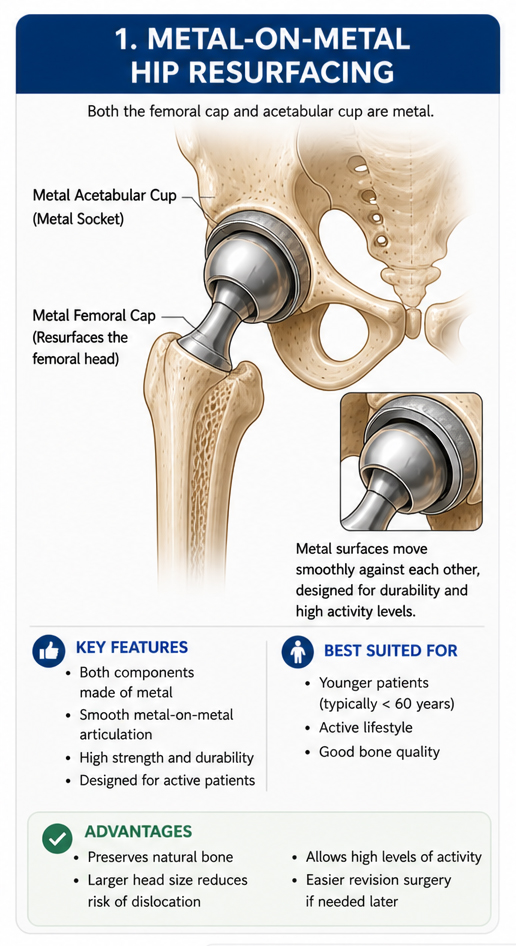
1. Metal-on-Metal Hip Resurfacing

This is the most common form of hip resurfacing.

Features

  • Both the femoral cap and acetabular cup are made of metal.
  • Provides smooth movement between joint surfaces.
  • Designed for durability and high activity levels.

Advantages

  • Preserves femoral bone
  • Lower risk of hip dislocation compared to some replacements
  • Allows higher physical activity levels


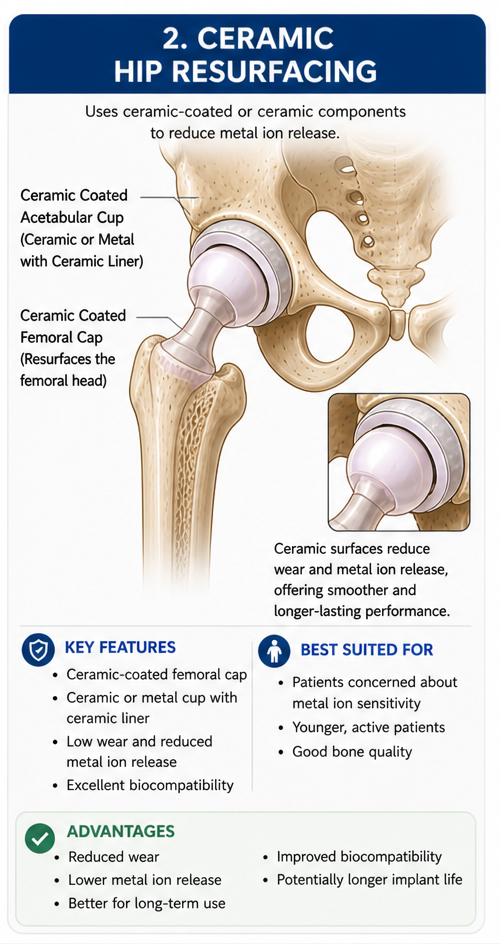
2. Ceramic Hip Resurfacing (Emerging Technology)

Some newer resurfacing designs use ceramic-coated surfaces.

Features

  • Ceramic-coated femoral cap
  • Ceramic or metal acetabular cup

Advantages

  • Reduced metal ion release
  • Improved wear resistance
  • Potentially longer implant life


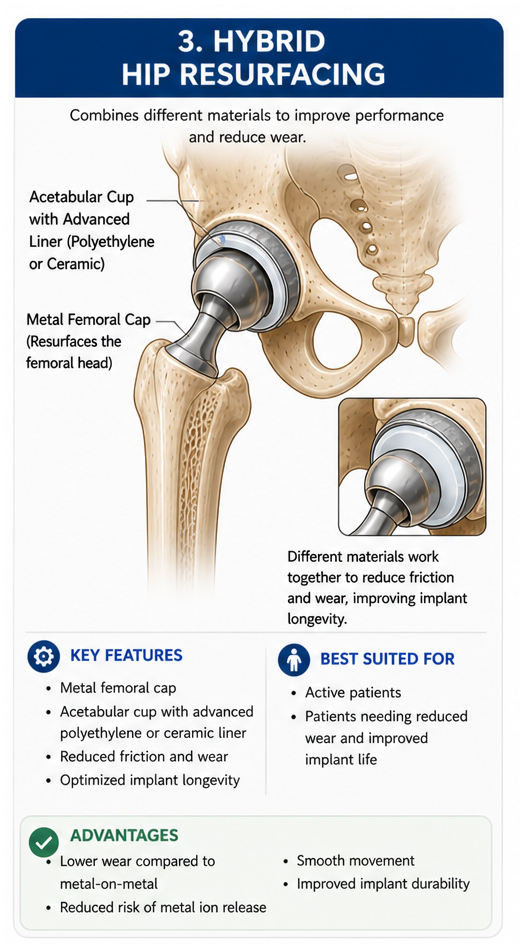
3. Hybrid Hip Resurfacing

This approach combines different materials for the femoral cap and socket.

Features

  • Metal femoral cap with specialized surface coating
  • Advanced polyethylene or ceramic socket liner

Advantages

  • Reduced friction and wear
  • Improved implant longevity


Conditions That May Require Hip Resurfacing

Doctors may recommend this procedure for patients suffering from:

  • Severe Osteoarthritis of the hip
  • Rheumatoid Arthritis
  • Hip joint degeneration
  • Post-traumatic arthritis
  • Avascular Necrosis of the femoral head (early stages)
Symptoms Indicating the Need for Surgery

Common symptoms include:

  • Persistent hip pain during activity
  • Reduced range of motion
  • Hip stiffness
  • Difficulty walking or climbing stairs
  • Pain even during rest in advanced stages
Components of a Hip Resurfacing Implant

Hip resurfacing implants usually include two components:

  1. Femoral Cap
    • A metal cap placed over the reshaped femoral head.
  2. Acetabular Cup
    • A metal socket inserted into the hip bone.

Together they recreate the natural ball-and-socket movement of the hip joint.

Advantages of Hip Resurfacing
  • Preserves more natural bone
  • Larger femoral head reduces risk of dislocation
  • Better joint stability
  • Easier revision surgery if needed later
  • Allows higher activity levels
Possible Risks and Complications

Although effective, potential risks may include:

  • Metal ion release in metal-on-metal implants
  • Femoral neck fracture (rare)
  • Infection
  • Implant loosening
  • Blood clots

Proper patient selection and surgical expertise help minimize these risks.