ACL

The Anterior Cruciate Ligament (ACL) is one of the four major ligaments of the knee joint that connects the thigh bone (femur) to the shin bone (tibia).

It plays a crucial role in stabilizing the knee, especially during activities that involve running, jumping, sudden stopping, or changing direction.

What is the Anterior Cruciate Ligament (ACL)?

The Anterior Cruciate Ligament (ACL) is one of the four major ligaments of the knee joint that connects the thigh bone (femur) to the shin bone (tibia). It plays a crucial role in stabilizing the knee, especially during activities that involve running, jumping, sudden stopping, or changing direction.

The ACL prevents the tibia from sliding forward in relation to the femur and provides rotational stability to the knee joint. Because of the high stress placed on the knee during sports, ACL injuries are among the most common ligament injuries in athletes.

Sports that frequently cause ACL injuries include:
  • Football (soccer)
  • Basketball
  • Cricket
  • Skiing
  • Tennis
  • Kabaddi
  • Badminton

Types of ACL Injuries

  • Grade 1 – Mild ACL Injury
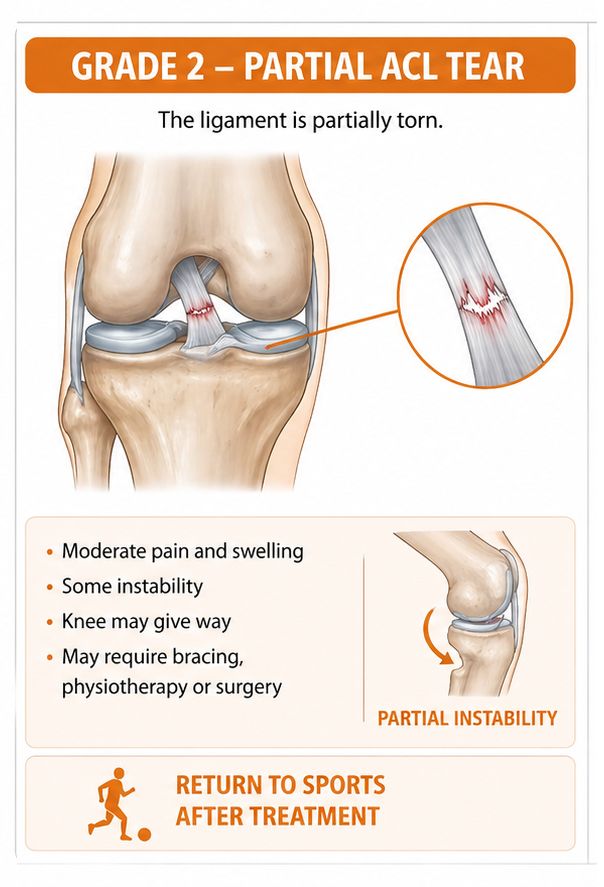
  • Grade 2 – Partial ACL Tear
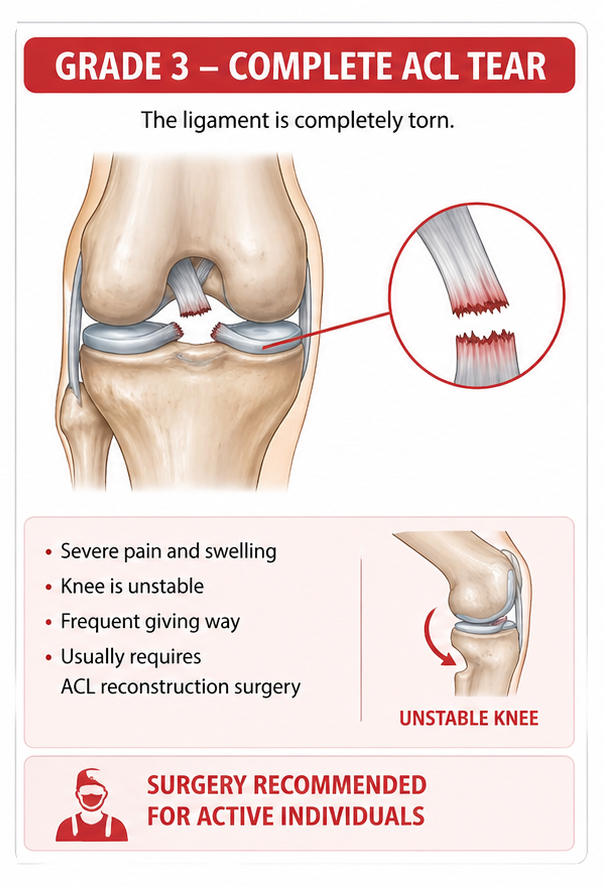
  • Grade 3 – Complete ACL Tear
https://drpraneetorthogoa.com/wp-content/uploads/2026/04/Grade-1.jpg
https://drpraneetorthogoa.com/wp-content/uploads/2026/04/Grade-2.jpg
https://drpraneetorthogoa.com/wp-content/uploads/2026/04/Grade-3.jpg

ACL injuries are generally classified based on severity and ligament damage.

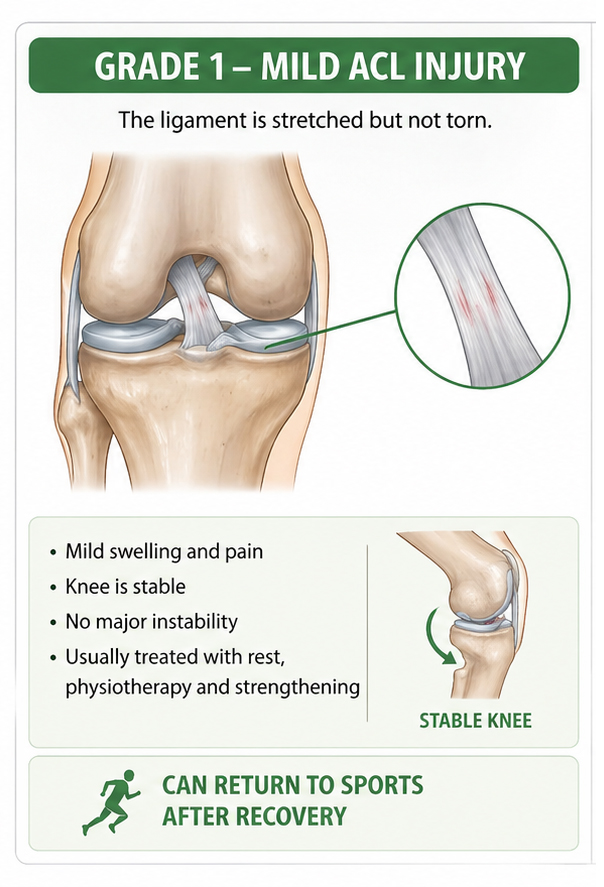
Grade 1 – Mild ACL Injury

  • The ligament is stretched but not torn
  • Knee stability is usually maintained
  • Mild pain and swelling
  • Often treated with rest and physiotherapy

Grade 2 – Partial ACL Tear

  • The ligament is partially torn
  • Moderate instability in the knee
  • Pain, swelling, and difficulty walking
  • May require bracing or surgical intervention depending on activity level

Grade 3 – Complete ACL Tear

  • The ligament is fully torn or ruptured
  • Knee becomes unstable
  • Severe swelling and inability to continue sports
  • Usually requires ACL reconstruction surgery
Signs and Symptoms of ACL Injury

Common symptoms include:

  • Sudden “pop” sound in the knee
  • Severe pain during movement
  • Rapid swelling within a few hours
  • Instability or knee giving way
  • Difficulty walking or bearing weight
  • Reduced range of motion

Athletes often cannot continue playing after the injury.

Diagnosis of ACL Injury

An orthopedic surgeon will diagnose ACL injuries through:

Physical Examination Tests

Common tests include:

  • Lachman Test
  • Anterior Drawer Test
  • Pivot Shift Test

These tests check knee stability and ligament integrity.

Imaging Tests

X-ray

  • Rules out bone fractures

MRI (Magnetic Resonance Imaging)

  • Gold standard for diagnosing ACL tears
  • Shows ligament damage, meniscus injury, and cartilage damage
Surgical Treatment: ACL Reconstruction

When the ACL is completely torn, especially in young or active individuals, surgery is often recommended.

ACL Reconstruction Surgery

Instead of repairing the torn ligament, surgeons usually replace it with a graft.

Common graft options include:

1. Patellar Tendon Graft

  • Uses a portion of the patellar tendon
  • Strong and widely used
  • Common in professional athletes

2. Hamstring Tendon Graft

  • Uses hamstring tendons
  • Less postoperative pain
  • Faster recovery in some patients

3. Quadriceps Tendon Graft

  • Uses part of the quadriceps tendon
  • Good option for revision surgeries

4. Allograft (Donor Tissue)

  • Tissue taken from a cadaver donor
  • Used in certain cases
Modern Surgical Techniques

Modern orthopedic surgery uses minimally invasive arthroscopic techniques.

Arthroscopic ACL Reconstruction

Benefits include:

  • Smaller incisions
  • Less pain
  • Faster recovery
  • Better visualization of the joint
  • Lower infection risk

During surgery:

  1. Small cameras (arthroscopes) are inserted into the knee.
  2. The torn ligament is removed.
  3. A graft is placed to reconstruct the ACL.
  4. Screws or fixation devices secure the graft.
When Should You See an Orthopedic Surgeon?

Consult an orthopedic specialist if you experience:

  • Sudden knee injury with popping sound
  • Persistent knee pain or swelling
  • Knee instability while walking or running
  • Difficulty bending or straightening the knee
  • Inability to continue sports activities

Early diagnosis can help prevent long-term joint damage and arthritis.