

Partial Hip Replacement

Partial Hip Replacement, medically known as hemiarthroplasty, is a surgical procedure in which only the damaged femoral head (the ball of the hip joint) is replaced with an artificial implant, while the natural acetabulum (hip socket) remains intact.

This procedure is commonly performed when the ball portion of the hip joint is severely damaged, but the socket is still healthy.

It is frequently recommended for hip fractures in elderly patients, especially fractures of the femoral neck.
What is Partial Hip Replacement

Partial Hip Replacement, medically known as hemiarthroplasty, is a surgical procedure in which only the damaged femoral head (the ball of the hip joint) is replaced with an artificial implant, while the natural acetabulum (hip socket) remains intact.

This procedure is commonly performed when the ball portion of the hip joint is severely damaged, but the socket is still healthy. It is frequently recommended for hip fractures in elderly patients, especially fractures of the femoral neck.

Types of Partial Hip Replacement

  • Unipolar Partial Hip Replacement
  • Bipolar Partial Hip Replacement
https://drpraneetorthogoa.com/wp-content/uploads/2026/05/1-Unipolar.jpg
https://drpraneetorthogoa.com/wp-content/uploads/2026/05/2-Bipolar.jpg

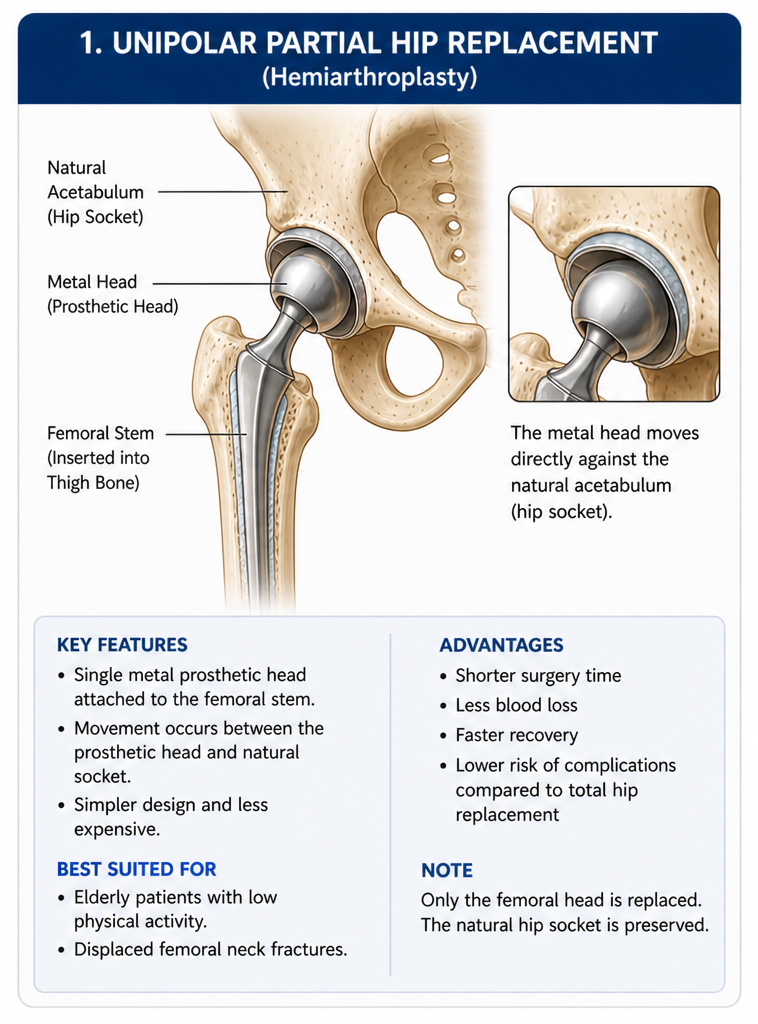
1. Unipolar Partial Hip Replacement

In this procedure, the artificial femoral head moves directly against the natural acetabulum (hip socket).

Key Features

  • Single metal prosthetic head attached to the femoral stem
  • Simpler implant design
  • Less expensive compared to bipolar implants
  • Movement occurs between the prosthetic head and natural socket

Best Used For

  • Elderly patients with low physical activity
  • Patients with displaced femoral neck fractures


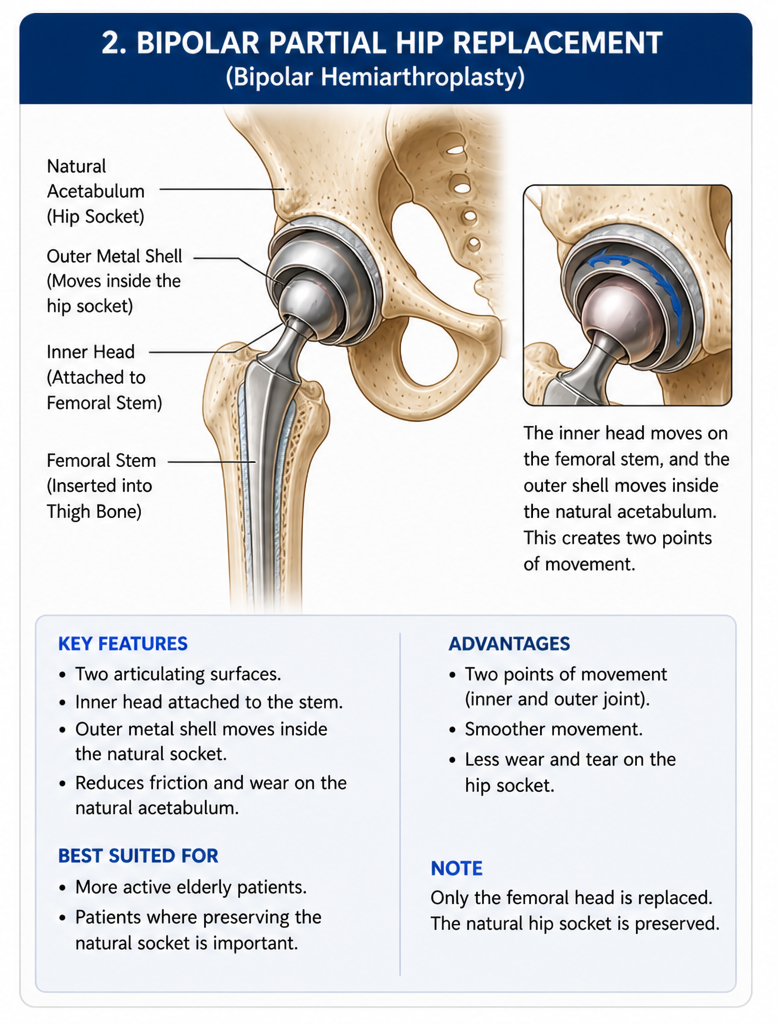
2. Bipolar Partial Hip Replacement

In bipolar hemiarthroplasty, the prosthesis has two articulating surfaces.

Structure

  • Inner head attached to the femoral stem
  • Outer metal shell that moves inside the hip socket

Key Features

  • Two points of movement (inner and outer joint)
  • Reduces friction and wear on the natural acetabulum
  • Provides smoother joint movement

Best Used For

  • More active elderly patients
  • Patients where preserving the natural socket is important
When is Partial Hip Replacement Recommended?

Doctors may recommend this surgery in conditions such as:

  • Femoral neck fractures
  • Severe hip trauma
  • Certain cases of hip arthritis affecting only the femoral head
  • Avascular necrosis (AVN) limited to the femoral head
  • Failed previous hip surgeries
Symptoms That May Require Surgery

Patients may require partial hip replacement if they experience:

  • Severe hip pain
  • Inability to bear weight on the leg
  • Difficulty walking or standing
  • Limited hip mobility
  • Pain after hip fracture
Diagnosis

Orthopedic specialists diagnose hip joint damage using:

  • Physical examination
  • X-rays
  • MRI scans
  • CT scans

These tests help determine whether partial or total hip replacement is more appropriate.

Advantages of Partial Hip Replacement
  • Shorter surgical time
  • Less blood loss
  • Faster recovery
  • Lower risk of complications compared to total hip replacement
  • Suitable for elderly patients
Possible Complications

Although uncommon, risks may include:

  • Hip dislocation
  • Infection
  • Implant loosening
  • Blood clots
  • Difference in leg length
Modern Advances in Partial Hip Replacement

Modern orthopedic surgery uses:

  • Minimally invasive surgical techniques
  • Improved prosthetic materials
  • Computer-assisted surgical planning
  • Enhanced rehabilitation protocols

These advances help improve implant longevity, mobility, and patient outcomes.