Revision Hip Replacement is a surgical procedure in which a previously implanted artificial hip joint is replaced or repaired with new components. It is performed when the original hip replacement implant fails, becomes loose, gets infected, wears out, or causes complications over time.
Compared to the first hip replacement surgery, revision surgery is more complex because the surgeon must remove the old implant, address bone loss or damage, and insert a new prosthetic joint.
Revision surgery may be recommended for several reasons:
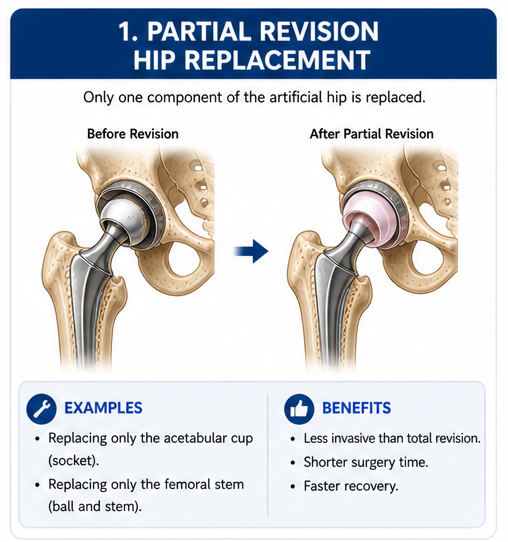
Only one component of the artificial hip (either the ball or the socket) is replaced.
Example:
Advantages
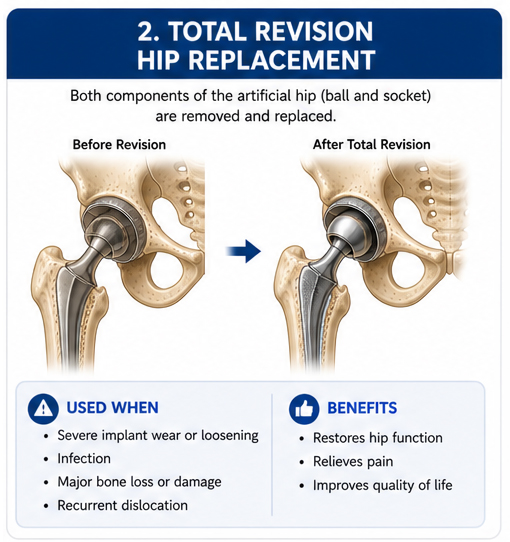
Both components of the prosthetic hip joint (ball and socket) are removed and replaced with new implants.
Used when
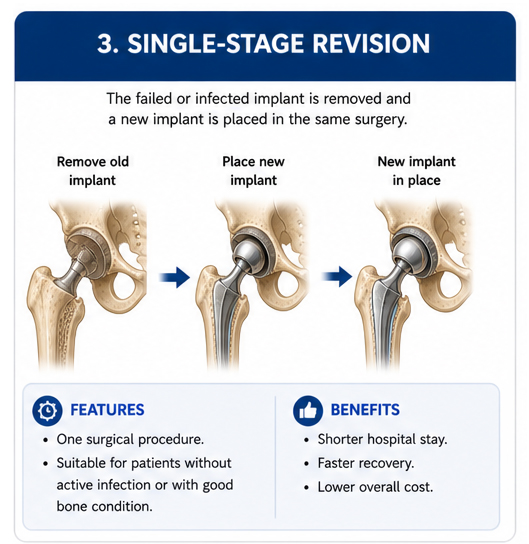
The infected or failed implant is removed and replaced with a new implant during the same surgery.
Advantages
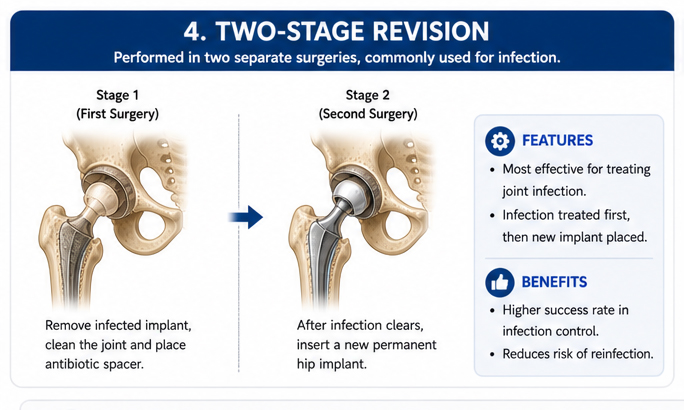
Performed in two separate surgeries, often used for infection.
Stage 1
Stage 2 (after infection clears)
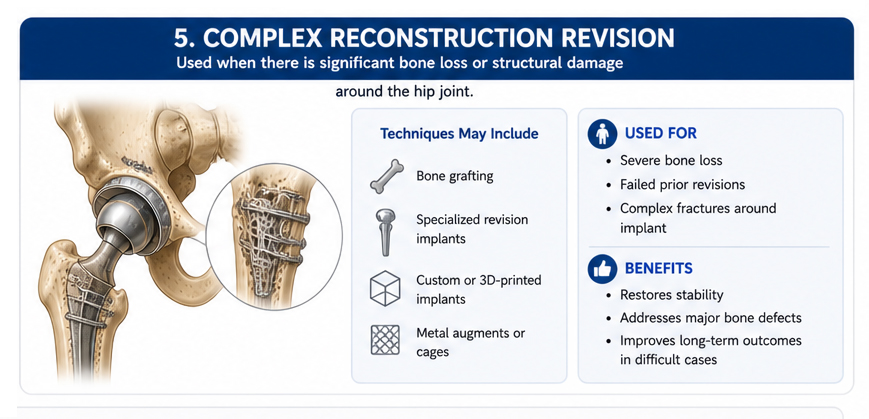
Used when there is significant bone loss or structural damage around the hip joint.
Surgeons may use:
Patients may experience:
If these symptoms appear years after hip replacement, a doctor may recommend evaluation.
Doctors use several tests:
These tests help determine the cause of implant failure.
As with any major surgery, risks include:
However, modern surgical techniques and improved implants have significantly increased success rates.
Recent innovations include:
These advancements help improve outcomes and reduce recovery time.