Recurrent Shoulder Dislocation

Recurrent Shoulder Dislocation is a condition in which the shoulder joint repeatedly slips out of its normal position after an initial dislocation.

This happens because the structures that stabilize the shoulder—such as ligaments, cartilage (labrum), and surrounding muscles—become stretched, torn, or weakened. As a result, even minor movements or injuries can cause the shoulder to dislocate again.

The shoulder joint is naturally the most mobile joint in the body, but this mobility also makes it more prone to instability and repeated dislocations.
What is Recurrent Shoulder Dislocation

Recurrent Shoulder Dislocation is a condition in which the shoulder joint repeatedly slips out of its normal position after an initial dislocation. This happens because the structures that stabilize the shoulder—such as ligaments, cartilage (labrum), and surrounding muscles—become stretched, torn, or weakened. As a result, even minor movements or injuries can cause the shoulder to dislocate again.

The shoulder joint is naturally the most mobile joint in the body, but this mobility also makes it more prone to instability and repeated dislocations.
Types of Recurrent Shoulder Dislocation

  • Anterior Recurrent Shoulder Dislocation
  • Posterior Recurrent Shoulder Dislocation
  • Inferior Recurrent Shoulder Dislocation
https://drpraneetorthogoa.com/wp-content/uploads/2026/05/Anterior-Recurrent-Shoulder-Dislocation.jpg
https://drpraneetorthogoa.com/wp-content/uploads/2026/05/Posterior-Recurrent.jpg
https://drpraneetorthogoa.com/wp-content/uploads/2026/05/Inferior.jpg

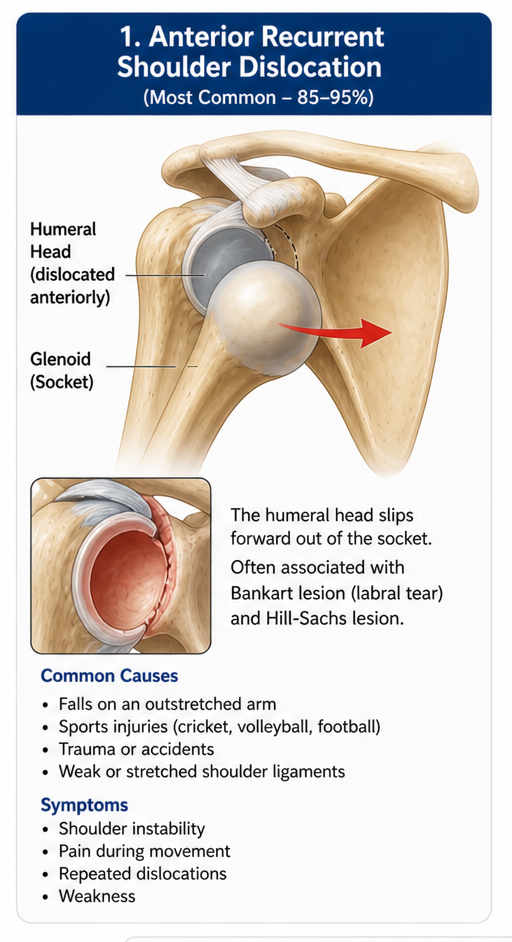
1. Anterior Recurrent Shoulder Dislocation

This is the most common type, accounting for about 85–95% of all shoulder dislocations.

What happens:
The head of the upper arm bone (humerus) slips forward out of the shoulder socket (glenoid).

Common causes

  • Sports injuries (cricket, volleyball, swimming, football)
  • Falls on an outstretched arm
  • Trauma or accidents
  • Weak shoulder ligaments after first dislocation
  • Associated injuries

    • Bankart lesion (tear of the labrum)
    • Hill-Sachs lesion (compression fracture of the humeral head)


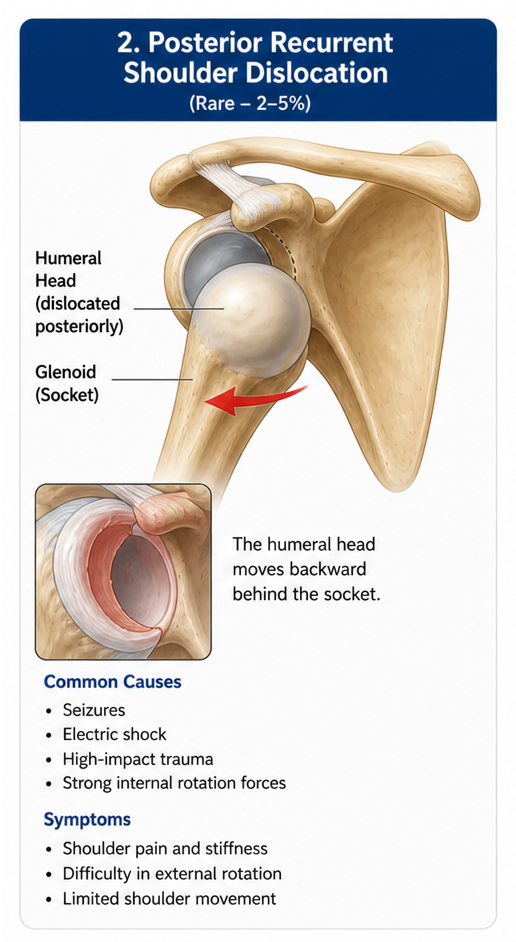
2. Posterior Recurrent Shoulder Dislocation

This type is rare, making up about 2–5% of shoulder dislocations.

What happens:
The humeral head moves backward behind the socket.

Common causes

  • Seizures
  • Electric shock
  • High-impact trauma
  • Strong internal rotation forces

Symptoms

  • Limited ability to rotate the arm outward
  • Shoulder pain and stiffness


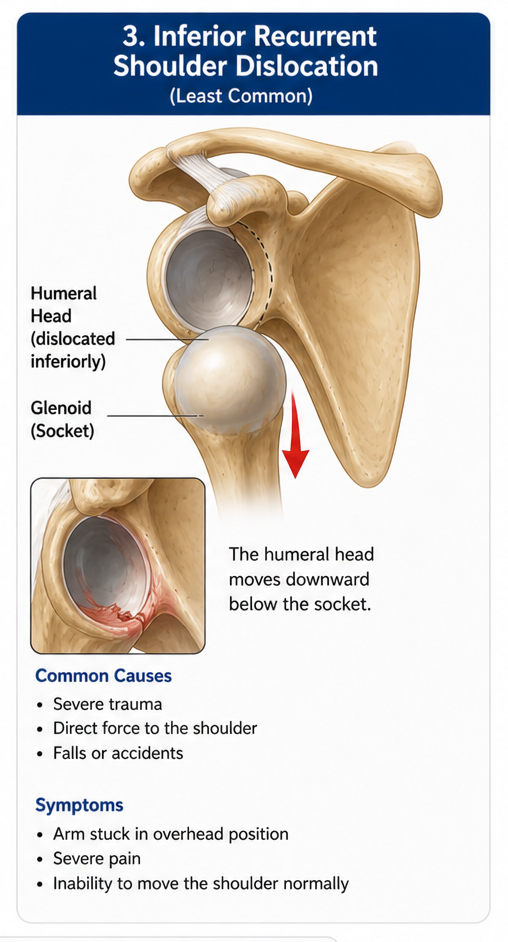
3. Inferior Recurrent Shoulder Dislocation

This is the least common type.

What happens:
The humeral head moves downward below the socket.

Typical signs

  • The arm becomes stuck in an overhead position
  • Severe pain and inability to move the shoulder normally

This condition is sometimes called luxatio erecta.


Causes of Recurrent Shoulder Dislocation

Several factors can lead to repeated dislocations:

  • Improper healing after the first dislocation
  • Ligament laxity (loose ligaments)
  • Labral tears
  • Weak shoulder muscles
  • Bone loss in the shoulder socket
  • High-impact sports or repeated overhead movements

Young athletes are particularly at risk.

Symptoms

Common symptoms include:

  • Shoulder slipping out repeatedly
  • Sudden shoulder pain
  • Feeling of instability or looseness
  • Difficulty lifting the arm
  • Shoulder weakness
  • Swelling or bruising after dislocation

Some patients experience partial dislocation (subluxation) where the joint slips but goes back into place.

Diagnosis

Doctors diagnose recurrent shoulder dislocation through:

Physical Examination

Checking joint stability and range of motion.

Imaging Tests

  • X-ray – identifies dislocation and bone injuries
  • MRI scan – detects ligament and labrum tears
  • CT scan – evaluates bone loss in severe cases
Surgical Treatment

Surgery is recommended when dislocations occur frequently.

Common procedures include:

Arthroscopic Shoulder Stabilization

  • Minimally invasive surgery
  • Repairs torn labrum and ligaments

Bankart Repair

  • Reattaches the torn labrum to the socket

Latarjet Procedure

  • Used when there is bone loss in the socket
  • Transfers a piece of bone to increase joint stability
Risk Factors
  • Age below 30 years
  • Participation in contact sports
  • Previous shoulder dislocation
  • Hypermobile joints
  • Weak shoulder muscles
Possible Complications

If untreated, recurrent shoulder dislocation may lead to:

  • Chronic shoulder instability
  • Cartilage damage
  • Early shoulder arthritis
  • Muscle weakness
  • Reduced range of motion
Summary

Recurrent shoulder dislocation occurs when the shoulder repeatedly slips out of place after the first injury. Early diagnosis, proper rehabilitation, and timely surgical treatment when necessary can restore stability and prevent long-term joint damage.