Bankart

A Bankart lesion is an injury to the labrum of the shoulder joint, specifically the anteroinferior part of the glenoid labrum.

The labrum is a ring of cartilage that surrounds the shoulder socket (glenoid) and helps stabilize the shoulder joint.

A Bankart lesion typically occurs when the shoulder dislocates forward (anterior shoulder dislocation), causing the labrum to tear away from the glenoid rim.

What is a Bankart Lesion

A Bankart lesion is an injury to the labrum of the shoulder joint, specifically the anteroinferior part of the glenoid labrum. The labrum is a ring of cartilage that surrounds the shoulder socket (glenoid) and helps stabilize the shoulder joint.

A Bankart lesion typically occurs when the shoulder dislocates forward (anterior shoulder dislocation), causing the labrum to tear away from the glenoid rim.

This injury leads to recurrent shoulder instability, meaning the shoulder may repeatedly slip out of place.

Key Point:

  • Most common in young athletes and active individuals
  • Often occurs during sports injuries, falls, or trauma

Research shows that up to 90–95% of recurrent anterior shoulder dislocations are associated with Bankart lesions.
Types of Bankart Lesions

  • Soft Tissue Bankart Lesion
  • Bony Bankart Lesion
  • Perthes Lesion
  • ALPSA Lesion
  • GLAD Lesion
https://drpraneetorthogoa.com/wp-content/uploads/2026/05/soft-tissue.jpg
https://drpraneetorthogoa.com/wp-content/uploads/2026/05/bony.jpg
https://drpraneetorthogoa.com/wp-content/uploads/2026/05/Perthes.jpg
https://drpraneetorthogoa.com/wp-content/uploads/2026/05/Alps.jpg
https://drpraneetorthogoa.com/wp-content/uploads/2026/05/Glad.jpg

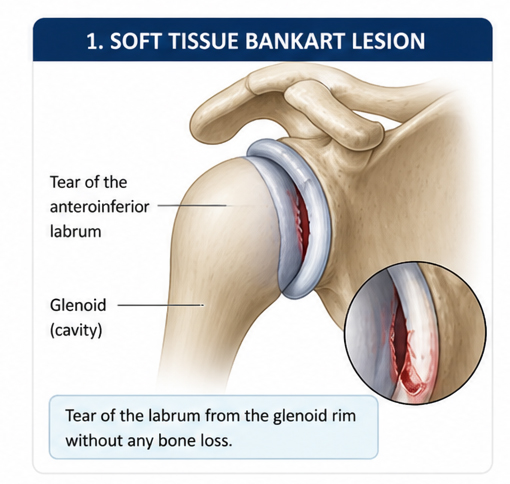
1. Soft Tissue Bankart Lesion

This is the most common type.

Characteristics

  • Tear of the anterior inferior labrum
  • No bone damage
  • Caused by anterior shoulder dislocation

Symptoms

  • Shoulder instability
  • Pain during overhead movements
  • Recurrent dislocations

Treatment

  • Physiotherapy
  • Arthroscopic Bankart repair


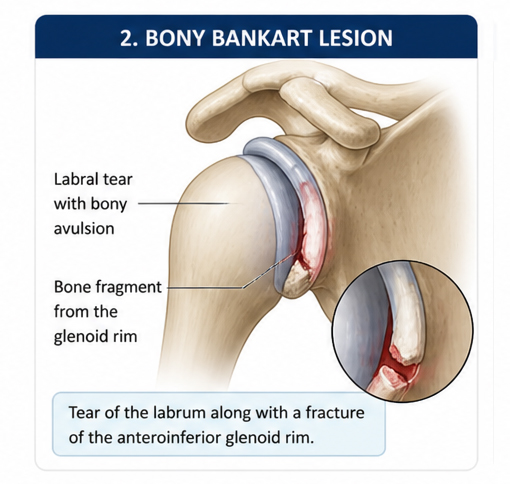
2. Bony Bankart Lesion

This occurs when a portion of the glenoid bone breaks along with the labrum.

Causes

Severe trauma such as:

  • Sports injuries
  • Falls
  • Road accidents

Research Data

Studies published in the Journal of Shoulder and Elbow Surgery report that 15–20% of anterior shoulder dislocations involve bony Bankart lesions.


Treatment

  • Arthroscopic repair
  • Bone graft reconstruction
  • Sometimes shoulder replacement in severe cases


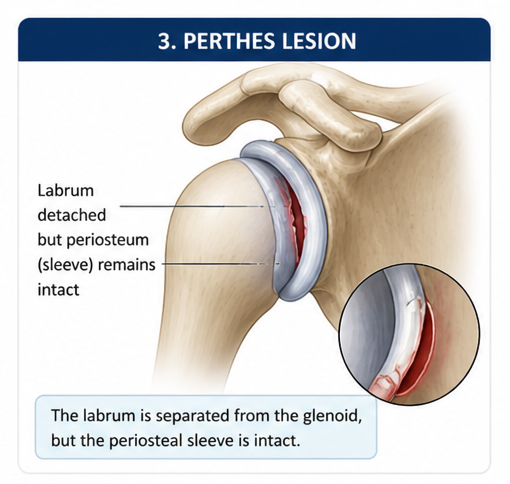
3. Perthes Lesion

In this type:

  • The labrum is torn but remains partially attached
  • The periosteum (bone covering) remains intact

Diagnosis

Often difficult to detect without MRI or MR arthrography.


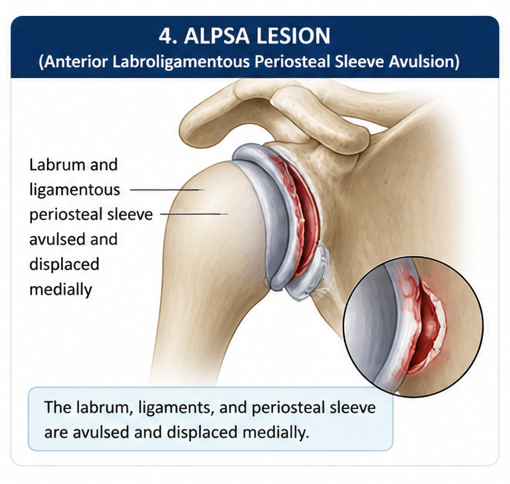
4. ALPSA Lesion

(Anterior Labroligamentous Periosteal Sleeve Avulsion)

In this injury:

  • Labrum and ligaments are torn and displaced medially
  • Shoulder instability becomes chronic

Research Insight

Orthopedic studies show ALPSA lesions are associated with higher recurrence rates if untreated.


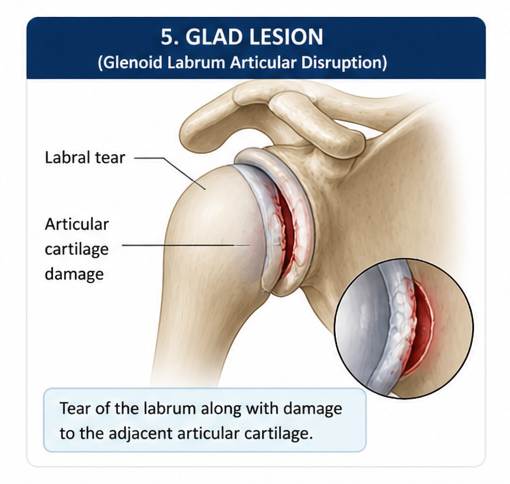
5. GLAD Lesion

(Glenolabral Articular Disruption)

This injury involves:

  • Labral tear
  • Damage to the articular cartilage of the glenoid

Symptoms often include:

  • Pain more than instability
Symptoms of a Bankart Lesion

Patients with Bankart lesions commonly experience:

1. Recurrent Shoulder Dislocation

The shoulder may repeatedly slip out of place.

2. Shoulder Instability

Feeling that the shoulder is loose or unstable.

3. Pain

Pain during:

  • Lifting
  • Throwing
  • Overhead movements

4. Clicking or Popping

Audible clicking inside the joint.

5. Weakness

Reduced strength in the shoulder.

Diagnosis of Bankart Lesion

Orthopedic surgeons use several diagnostic tools:

Physical Examination

Tests include:

  • Apprehension test
  • Relocation test

Imaging Tests

1. X-ray

  • Detects dislocations or fractures

2. MRI Scan

  • Identifies soft tissue damage

3. MR Arthrogram

  • Gold standard for detecting labral tears

Research Data

MRI arthrogram has a diagnostic accuracy of about 90–95% for detecting Bankart lesions.

Treatment Options for Bankart Lesions

Treatment depends on:

  • Patient age
  • Activity level
  • Severity of injury
  • Number of dislocations
Surgical Treatment for Bankart Lesion

Surgery is recommended for:

  • Recurrent shoulder dislocation
  • Athletes
  • Significant labral tears
Key Research Insights

Recent orthopedic research highlights:

  • Bankart lesions occur in up to 90% of traumatic anterior shoulder dislocations
  • Young athletes under 25 have the highest recurrence risk
  • Arthroscopic repair success rates exceed 85–95%
  • Advanced surgical techniques significantly improve long-term outcomes
Conclusion

Bankart lesions are a major cause of recurrent shoulder instability, particularly in athletes and active individuals. Early diagnosis and appropriate treatment—whether through physiotherapy or surgery—can restore shoulder stability and prevent long-term complications.

Modern procedures such as arthroscopic Bankart repair, Latarjet surgery, and advanced shoulder replacement techniques have significantly improved patient outcomes, allowing many individuals to return to normal activities and sports with restored shoulder function.