
Collateral Ligament Injury

A Collateral Ligament Injury is a condition in which one of the side ligaments of the knee joint becomes stretched, partially torn, or completely torn due to trauma, sudden twisting, or direct impact to the knee.

Collateral ligaments help stabilize the knee and control side-to-side movement between the thigh bone (Femur) and the shin bone (Tibia). When these ligaments are damaged, the knee may become painful, swollen, and unstable.

What is a Collateral Ligament Injury?

A Collateral Ligament Injury is a condition in which one of the side ligaments of the knee joint becomes stretched, partially torn, or completely torn due to trauma, sudden twisting, or direct impact to the knee.

Collateral ligaments help stabilize the knee and control side-to-side movement between the thigh bone (Femur) and the shin bone (Tibia). When these ligaments are damaged, the knee may become painful, swollen, and unstable.

The two main collateral ligaments in the knee are the Medial Collateral Ligament and the Lateral Collateral Ligament.
Types of Collateral Ligament Injuries

  • Medial Collateral Ligament (MCL) Injury
  • Lateral Collateral Ligament (LCL) Injury
https://drpraneetorthogoa.com/wp-content/uploads/2026/04/Medial-Collateral.jpg
https://drpraneetorthogoa.com/wp-content/uploads/2026/04/Lateral-Collateral.jpg

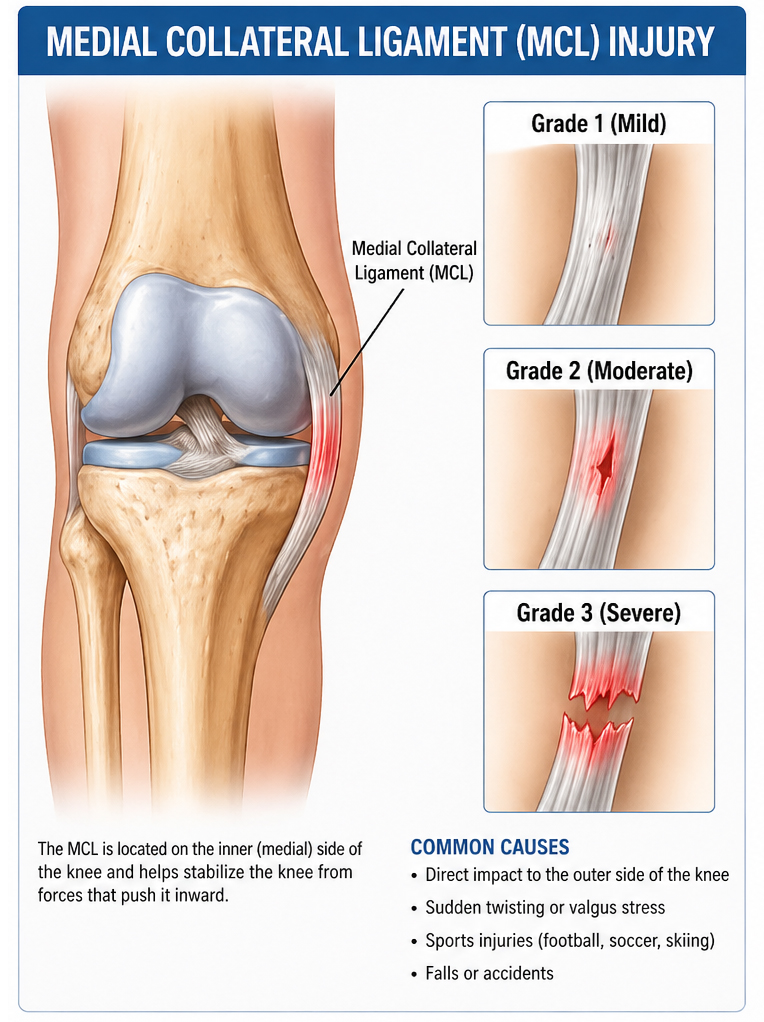
1. Medial Collateral Ligament (MCL) Injury

The MCL is located on the inner side of the knee and prevents the knee from bending inward.

Common causes:

  • Direct blow to the outer side of the knee
  • Sports injuries (football, soccer, skiing)
  • Sudden twisting or pivoting movements

Symptoms:

  • Pain on the inner side of the knee
  • Swelling
  • Knee instability
  • Tenderness along the ligament

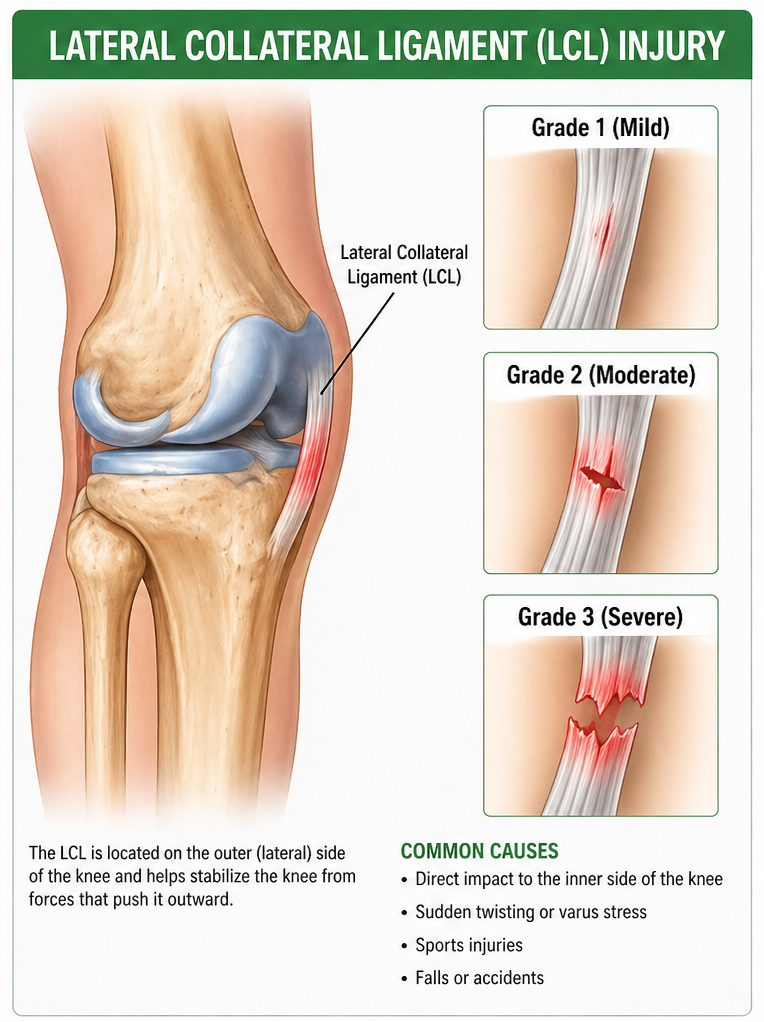
2. Lateral Collateral Ligament (LCL) Injury

The LCL is located on the outer side of the knee and prevents the knee from bending outward.

Common causes:

  • Direct impact to the inner side of the knee
  • Trauma during sports
  • Car accidents or severe injuries

Symptoms:

  • Pain on the outer side of the knee
  • Swelling
  • Difficulty bending the knee
  • Knee instability
Symptoms of Orthopaedic Trauma

Common symptoms include:

  • Severe pain at injury site
  • Swelling and bruising
  • Difficulty moving the joint or limb
  • Visible deformity of bone
  • Limited range of motion
  • Numbness or weakness
  • Inability to bear weight

Immediate medical evaluation is recommended when these symptoms occur.

Grades of Collateral Ligament Injuries
Collateral ligament injuries are classified into three grades based on severity.

Grade 1 – Mild Sprain

  • Ligament fibers are stretched but not torn.
  • Mild pain and tenderness.
  • Knee remains stable.

Grade 2 – Partial Tear

  • Partial tearing of the ligament.
  • Moderate pain and swelling.
  • Some instability in the knee.

Grade 3 – Complete Tear

  • Ligament is completely torn.
  • Severe pain and swelling.
  • Significant knee instability and difficulty walking.
Causes of Collateral Ligament Injuries

Common causes include:

  • Sports injuries
  • Sudden twisting movements
  • Direct blow to the knee
  • Falls or accidents
  • High-impact trauma

Collateral ligament injuries often occur along with injuries to other structures such as the Anterior Cruciate Ligament, Posterior Cruciate Ligament, or the Meniscus.

Symptoms of Collateral Ligament Injury

Patients with collateral ligament injuries may experience:

  • Knee pain on the inner or outer side
  • Swelling around the knee
  • Tenderness when touching the ligament
  • Knee instability or feeling that the knee may give way
  • Difficulty walking or bending the knee
Diagnosis

Orthopedic specialists diagnose collateral ligament injuries using:

  • Physical examination
  • MRI Scan to detect ligament tears
  • X-ray to rule out fractures
  • Knee Arthroscopy in complex cases
Surgical Treatment Options

Surgery may be required in severe cases, especially Grade 3 tears or combined ligament injuries.

1. Ligament Repair

  • The torn ligament is stitched or reattached to the bone.
  • Usually performed using minimally invasive techniques.

2. Ligament Reconstruction

  • The damaged ligament is replaced with a graft (tendon from the patient or donor).
  • Commonly used for severe LCL injuries or multiple ligament damage.

3. Arthroscopic Surgery

Performed using Knee Arthroscopy, where a small camera and instruments are inserted through small incisions to repair the ligament.

When Should You See an Orthopedic Surgeon?

You should consult an orthopedic specialist if:

  • Knee pain persists after injury
  • There is significant swelling
  • Knee feels unstable while walking
  • You cannot bear weight on the knee
  • The knee locks or gives way

Early diagnosis helps prevent complications such as Knee Osteoarthritis or chronic knee instability.

Summary

Collateral ligament injuries affect the side ligaments of the knee that provide stability. They may range from mild sprains to complete tears. While many cases heal with conservative treatment, severe injuries may require surgical repair or reconstruction to restore knee stability and function.