PCL

The Posterior Cruciate Ligament (PCL) is one of the four major ligaments of the knee joint. It connects the thigh bone (femur) to the shin bone (tibia) and is located behind the Anterior Cruciate Ligament (ACL) inside the knee.

The PCL plays a crucial role in stabilizing the knee joint, preventing the tibia from moving too far backward relative to the femur. It is stronger and thicker than the ACL, making PCL injuries less common but still serious.
Posterior Cruciate Ligament (PCL) Injury

Definition of PCL

The Posterior Cruciate Ligament (PCL) is one of the four major ligaments of the knee joint. It connects the thigh bone (femur) to the shin bone (tibia) and is located behind the Anterior Cruciate Ligament (ACL) inside the knee.

The PCL plays a crucial role in stabilizing the knee joint, preventing the tibia from moving too far backward relative to the femur. It is stronger and thicker than the ACL, making PCL injuries less common but still serious.
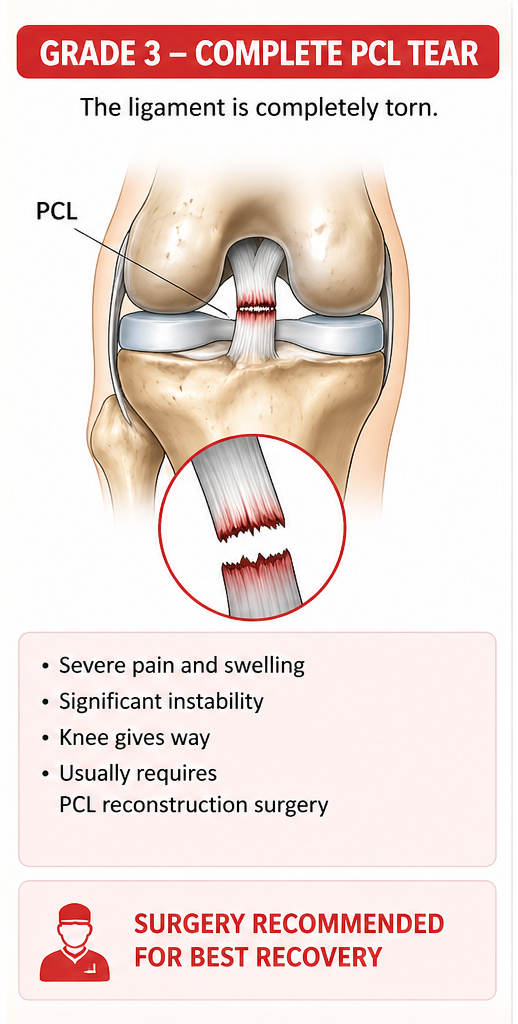
Types / Grades of PCL Injuries

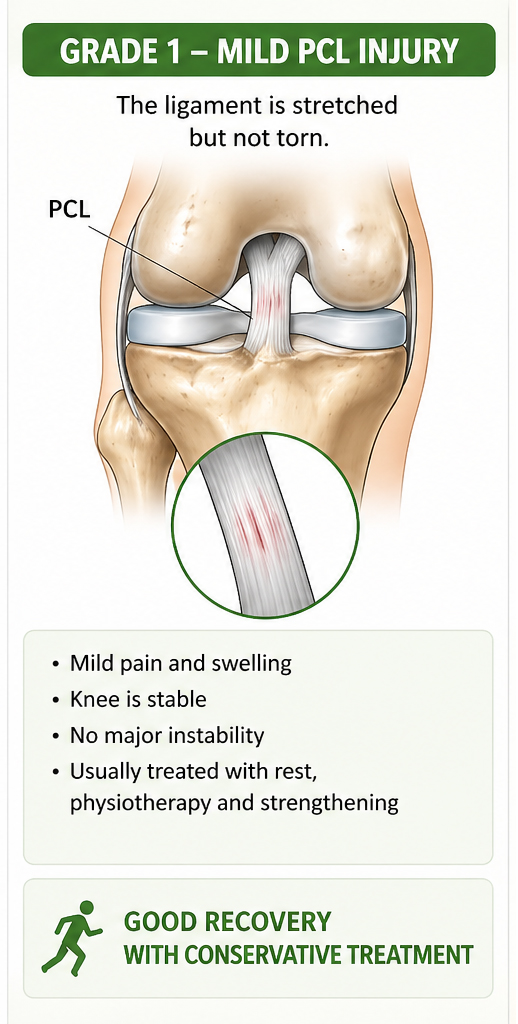
  • Grade 1 – Mild PCL Injury
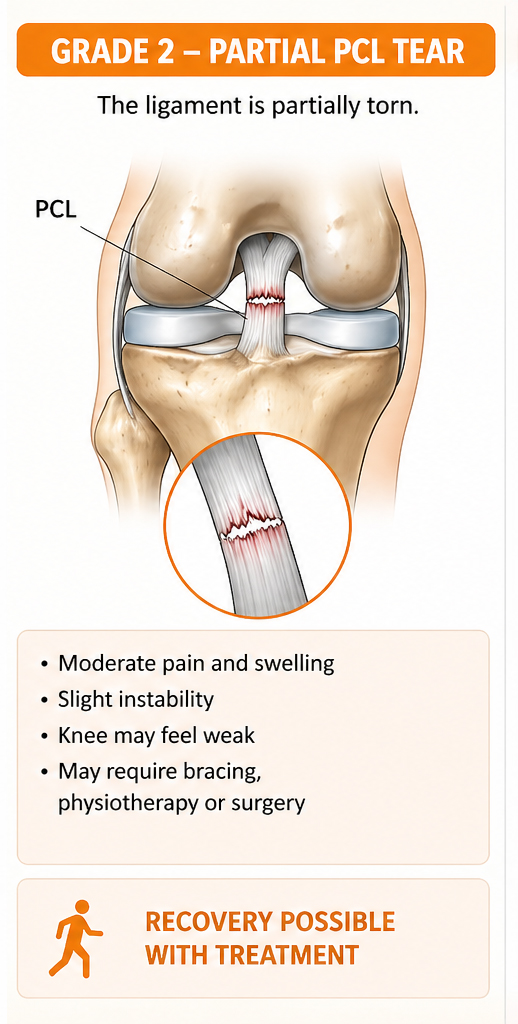
  • Grade 2 – Partial PCL Tear
  • Grade 3 – Complete PCL Tear
https://drpraneetorthogoa.com/wp-content/uploads/2026/04/Grade-1-Mild.jpg
https://drpraneetorthogoa.com/wp-content/uploads/2026/04/Grade-2-Partial.jpg
https://drpraneetorthogoa.com/wp-content/uploads/2026/04/Grade-3-Comlete-PCL.jpg

PCL injuries are classified based on the severity of ligament damage.

Grade 1 – Mild PCL Injury

  • The ligament is stretched but not torn
  • Mild swelling and pain
  • Knee remains stable
  • Minimal functional limitation

Treatment: Usually conservative (rest, physiotherapy).


Grade 2 – Partial PCL Tear

  • Ligament is partially torn
  • Moderate swelling and pain
  • Knee may feel slightly unstable
  • Difficulty walking or climbing stairs

Treatment: Bracing and rehabilitation; surgery rarely needed.


Grade 3 – Complete PCL Tear

  • Ligament is completely torn
  • Significant swelling and instability
  • Knee may feel like it gives way
  • Often associated with other ligament injuries

Treatment: Surgical reconstruction may be required.

Functions of the PCL

The PCL helps maintain proper knee stability by:

  • Preventing backward movement of the tibia
  • Stabilizing the knee during walking, running, and bending
  • Supporting the knee during sudden stops or changes in direction
  • Helping maintain overall joint alignment
Causes of PCL Injuries

PCL injuries typically occur due to direct trauma or high-impact injuries.

Common causes include:

  • Car accidents (dashboard injury when the knee hits the dashboard)
  • Sports injuries (football, rugby, basketball)
  • Falling directly onto a bent knee
  • Hyperextension of the knee
  • Severe twisting injuries

Sports that frequently involve PCL injuries include football, soccer, skiing, and wrestling.

Symptoms of a PCL Injury

Common signs include:

  • Pain in the back of the knee
  • Knee swelling
  • Difficulty walking
  • Knee instability
  • Reduced range of motion
  • Stiffness in the knee
  • Feeling that the knee slips backward

Some mild PCL injuries may not cause severe symptoms initially.

Diagnosis of PCL Injuries

Orthopedic specialists diagnose PCL injuries using:

1. Physical Examination

Doctors perform specific tests such as:

  • Posterior Drawer Test
  • Quadriceps Active Test
  • Dial Test

2. Imaging Tests

  • X-rays – to detect fractures
  • Magnetic Resonance Imaging (MRI) – best method to confirm ligament damage
  • CT Scan – used in complex trauma cases
Surgical Treatment – PCL Reconstruction

Surgery may be recommended when:

  • There is a complete PCL tear
  • Knee instability persists
  • Multiple ligaments are injured
  • Patient is an athlete or highly active individual

Procedure

PCL reconstruction involves:

  • Removing the damaged ligament
  • Replacing it with a graft (tendon from the patient or donor)

Common graft sources include:

  • Hamstring tendon
  • Patellar tendon
  • Donor graft (allograft)

The procedure is typically done using minimally invasive arthroscopic surgery.

When Should You See an Orthopedic Doctor?

Consult an orthopedic specialist if you experience:

  • Knee swelling after an injury
  • Severe knee pain
  • Difficulty walking
  • Knee instability
  • Knee locking or stiffness
  • Limited movement of the knee

Early diagnosis helps prevent long-term joint damage or arthritis.

Key Facts About PCL Injuries
  • PCL injuries account for less than 20% of ligament injuries in the knee.
  • The PCL is twice as strong as the ACL.
  • Many mild PCL injuries heal well with non-surgical treatment.
  • Severe injuries may require surgical reconstruction.